Bective Abbey in a Nutshell: 10 Key Facts
Bective Abbey is a Cistercian monastery on the banks of the River Boyne in County Meath, founded in 1147 as a daughter house of Mellifont. Its surviving cloister, towers and church walls are among the finest medieval monastic ruins in the Boyne Valley, later known also as a filming location for Braveheart.
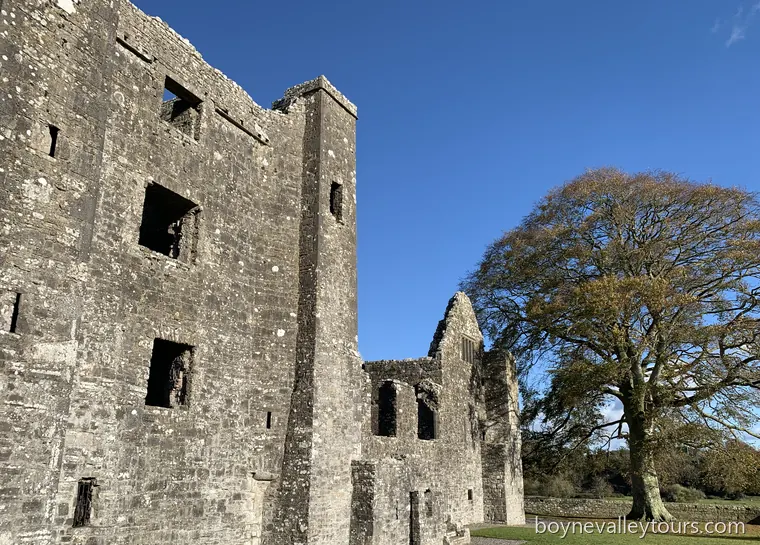 Bective Abbey, County Meath
- Founded in the 12th century. Bective Abbey was founded in 1147 by Murchad Ua Máelsechnaill, King of Meath.
- A Cistercian daughter house of Mellifont. It was established as a daughter house of Mellifont Abbey and was the second earliest Cistercian foundation in Ireland.
- Its name reflects a religious meaning. The name Bective is thought to derive from the Latin Beatitudo Dei, meaning “Blessedness of God”.
- Founded on fertile Boyne Valley farmland. Unlike earlier monasteries that sought isolation, Bective was established on productive agricultural land and became a major estate center.
- Burial place of Hugh de Lacy. In 1195 the headless body of Hugh de Lacy, the Anglo-Norman Lord of Meath and builder of Trim Castle, was reinterred at Bective Abbey. His head went to St Thomas’ Abbey in Dublin, and the head and body were later reunited there.
- Political influence in the Pale. By the later medieval period, the abbot of Bective acted as a spiritual lord and held a seat in the Parliament of the Pale.
- Anglo-Norman dominance. In the later Middle Ages the community became dominated by Anglo-Normans, and by 1386 men of Irish birth were effectively barred from entry.
- Late medieval rebuilding. Most of the surviving structures, including the fine cloister, date to the 15th century when the abbey was under FitzGerald patronage.
- Fortified monastic complex. During the 15th century the abbey was fortified with towers, reflecting both wealth and the need for defense.
- Dissolution and later reuse. Bective Abbey was dissolved in the mid 16th century, later converted into a manor house, and is now well-known as a filming location for Braveheart.
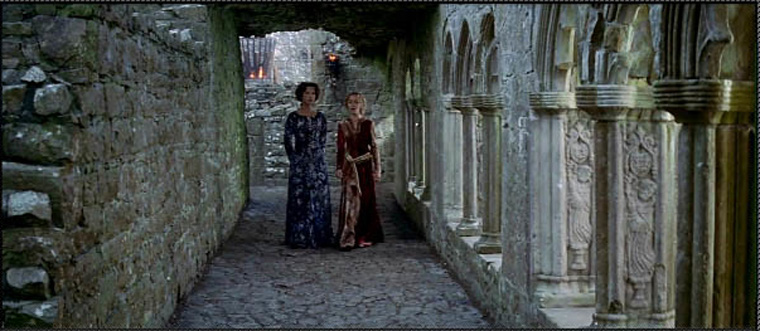 Bective Abbey Cloister in the movie Braveheart
Together with nearby Trim Castle, Bective Abbey was used as a location during the shooting of Mel Gibson's 1995 historical action-drama movie Braveheart. The cloister was used for the scene with the princess and her maid.
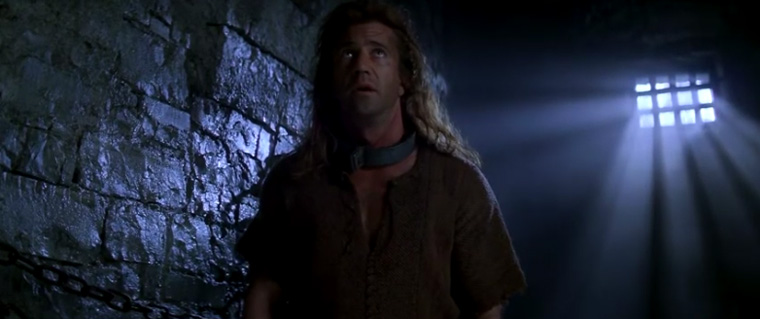 William Wallace (Mel Gibson) in a Braveheart dungeon scene filmed at
Trim Castle
William Wallace (Mel Gibson) in a Braveheart dungeon scene filmed at
Trim Castle
Bective Abbey, a 12th century Cistercian monastery on the banks of the River Boyne
Bective Abbey is a Cistercian monastery founded in 1147 by Murchad Ua Máelsechnaill, King of Meath, as a daughter house of Mellifont Abbey. It is the second Cistercian monastery founded in Ireland after Mellifont Abbey.
The name Bective is thought to derive from the Latin Beatitudo Dei, meaning “Blessedness of God”. Unlike many Cistercian foundations which sought isolation, Bective was established on fertile agricultural land in the Boyne Valley, and it quickly became an important ecclesiastical center.
In 1195 the headless body of Hugh de Lacy, the Anglo-Norman Lord of Meath who built Trim Castle, was reinterred at the abbey. His head went to St Thomas’ Abbey in Dublin, and the head and body were later reunited and reinterred in St Thomas’.
Bective Abbey became dominated by an Anglo-Norman community in the later medieval period, and in 1386 men of Irish birth were effectively barred from entering the monastery.
By the later medieval period, Bective Abbey had become an institution of considerable importance, with the abbot acting as a spiritual lord and taking a seat in the Parliament of the Pale.
The Cistercian order was founded on work and prayer, and they were innovative farmers. Their holdings in Ireland were transformed into highly productive estates, and by the 16th century the Cistercians of Bective had become wealthy from rents, tithes, and donations.
Bective Abbey was investigated during excavations led by Geraldine Stout and Matthew Stout. The work highlighted the abbey’s role as a significant agricultural center for its surrounding hinterland estates. Archaeobotanical evidence also suggests a kitchen garden with herbs and vegetables including cabbage, mustard, dock, sorrel, radishes, pulses, and elderberries.
The abbey you can see today is a complex combination of different phases of construction, with rebuilding and repurposing reflecting more than five centuries of use. Most of the surviving structures, including the fine cloister, date to the 15th century when the abbey was under the patronage of the powerful FitzGeralds. It was also at this time that the abbey was fortified, with strong towers constructed to protect the site.
At the time Bective was dissolved during the Dissolution of the Monasteries in the mid 16th century, it was recorded that the estate contained 1,580 acres. The abbey and its possessions were purchased in 1552 by Andrew Wyse. After further changes of ownership, it was transformed into a manor in the early 17th century, and later came into the hands of the Bolton family before being donated to the state in 1894.
Bective Abbey is in the care of the OPW and is free to visit. The ruins stand in open ground beside the Boyne, with uneven grass and stone underfoot.