Fourknocks in a Nutshell – 10 Key Facts
Fourknocks is a smaller Neolithic passage tomb in County Meath, dating to around 3000 BC and set in open farmland southeast of the Boyne Valley. Its chamber is noted for distinctive carved art, including zigzag patterns and a rare possible human face.
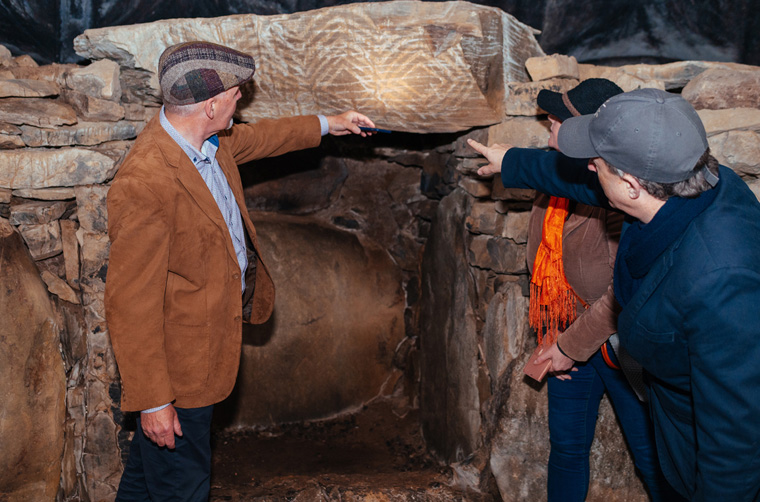 Fourknocks Passage Tomb dating back 5,000 years
- Fourknocks is a Neolithic passage tomb, generally dated to around 3000 BC, making it broadly contemporary with the major Boyne Valley passage tombs such as Newgrange, Knowth and Dowth, located about 15 km to the north-west.
- It is a smaller, local-scale monument, following the same core idea as larger passage tombs: a mound with a short stone-lined passage leading to a chamber used for burial and ceremony.
- The mound originally measured about 30 metres in diameter, a substantial communal construction that required organised labour and careful planning despite its more modest scale.
- The passage is approximately 5 metres long, significantly shorter than the 19 metre passage at Newgrange, highlighting variation in passage tomb design rather than a single standard model.
- The stone-lined passage leads into a chamber with side recesses, a layout closely associated with the deposition of cremated human remains in Irish passage tombs.
- Excavation revealed cremated and unburnt human remains, representing a large number of individuals, along with artefacts such as pendants, beads, chalk marbles and bone pins.
- Some stones are decorated with angular-style megalithic art, carved mainly on sandstone, showing that symbolic decoration was not confined to the largest monuments of the Boyne Valley.
- One carved stone is often interpreted as anthropomorphic, possibly representing a stylised face and torso, comparable to figures known from Neolithic sites in Brittany and the Iberian Peninsula.
- The size and form of the chamber suggest it was not fully stone-roofed, with excavation evidence including central timber post holes, pointing instead to a lighter superstructure, possibly using timber and turf.
- Fourknocks was excavated in 1950 by P. J. Hartnett, and the chamber was later protected with a modern concrete dome by the OPW, allowing the interior to be preserved and safely accessible for visitors.
Fourknocks, a Neolithic passage tomb dating to around 3000 BC.
Fourknocks is a Neolithic passage tomb dating to around 3000 BC, placing it in the same broad period as Newgrange, which lies approximately 15 kilometres to the north-west. Although much smaller in scale, Fourknocks reflects the same cultural tradition of communal burial and ritual activity that characterises the great passage tombs of the Boyne Valley.
The monument consists of a circular mound, originally about 30 metres in diameter, with a stone-lined passage approximately 5 metres long leading into the chamber. This is significantly shorter than the 19 metre passage at Newgrange and illustrates the variation in design found among Irish passage tombs rather than a single standardised form.
The name Fourknocks derives from the Irish Fuar Chnuic, meaning “Cold Hills”, a reference to the local landscape rather than to the monument itself. Unlike Newgrange, the entrance at Fourknocks faces roughly north-east and there is no evidence for a deliberate solar alignment with the rising or setting sun.
Excavation carried out in 1950 by P. J. Hartnett uncovered a substantial quantity of human remains, representing at least sixty individuals. These included both cremated and unburnt bone, mainly skull fragments and long bones, deposited within the chamber and side recesses. Associated finds such as pendants, beads, chalk marbles and bone pins confirm the ceremonial and funerary role of the monument.
Megalithic art is present on several stones at Fourknocks, carved in an angular style on large sandstone slabs. One stone is often interpreted as anthropomorphic, possibly representing a stylised face and torso, with parallels drawn to Neolithic carvings in Brittany and the Iberian Peninsula.
The chamber at Fourknocks is unusually wide, and excavation evidence including a timber post hole suggests it may not have been fully stone-roofed. Instead, it is likely that a lighter superstructure incorporating timber and turf formed part of the original design. Today the chamber is protected by a modern concrete dome installed by the OPW to safeguard the monument.
Fourknocks forms part of a wider prehistoric landscape in this area of County Meath, which also includes the henge and mound at Micknanstown to the north. From the top of the mound, there are broad views across the surrounding countryside, with the Wicklow Mountains visible to the south and the Cooley Mountains and Mourne Mountains to the north, emphasising the monument’s setting within a carefully chosen landscape.