
Hill of Slane in a Nutshell: 10 Key Facts
The Hill of Slane rises above the Boyne Valley and is traditionally linked with Saint Patrick lighting the Paschal fire. Today its friary tower, college ruins and graveyard crown the hill with wide views across County Meath.
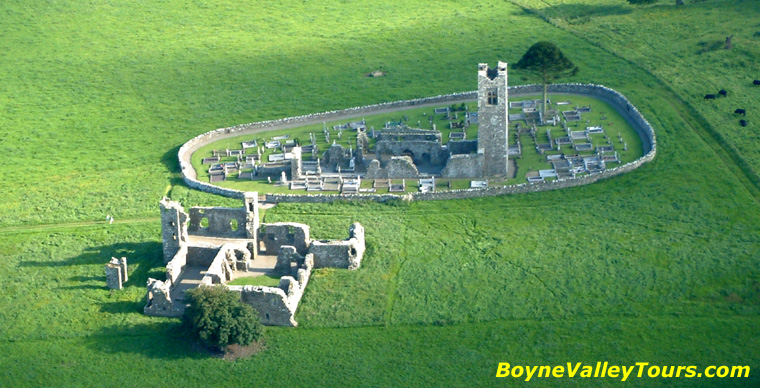 Hill of Slane aerial view, with the friary tower and college ruins.
- A prominent hill overlooking the River Boyne. The Hill of Slane rises above Slane village in County Meath and commands wide views across the Boyne Valley.
- Traditionally linked with Saint Patrick. According to early medieval tradition, Saint Patrick lit the Paschal fire on the Hill of Slane around AD 433, defying the pagan festival fire at the Hill of Tara.
- An early Christian foundation. The hill is associated with Saint Erc of Slane, to whom the foundation of an early monastery on the site is traditionally attributed.
- Long continuity of religious use. Historical sources indicate that the Hill of Slane remained an important ecclesiastical site from the early medieval period through the later Middle Ages.
- A late medieval Franciscan friary. The most visible ruins today belong to a Franciscan friary founded in 1512 by Sir Christopher Fleming, Lord of Slane.
- A college with a defined community. The friary included a residential college built to accommodate four priests, four lay brothers, and four choristers.
- Buildings arranged around a quadrangle. The friary complex was laid out around a central courtyard, with domestic ranges and a church forming a compact monastic enclosure.
- A striking church tower. The tall west tower of the friary church remains a dominant feature on the hill and is visible from much of the surrounding countryside.
- Dissolution and later reuse. The friary was dissolved during the Dissolution of the Monasteries in the mid 16th century, with limited later reoccupation in the 17th century.
- An atmospheric Boyne Valley landmark. Today, the Hill of Slane is valued for its historical associations, medieval ruins, and panoramic views across the Boyne Valley landscape.
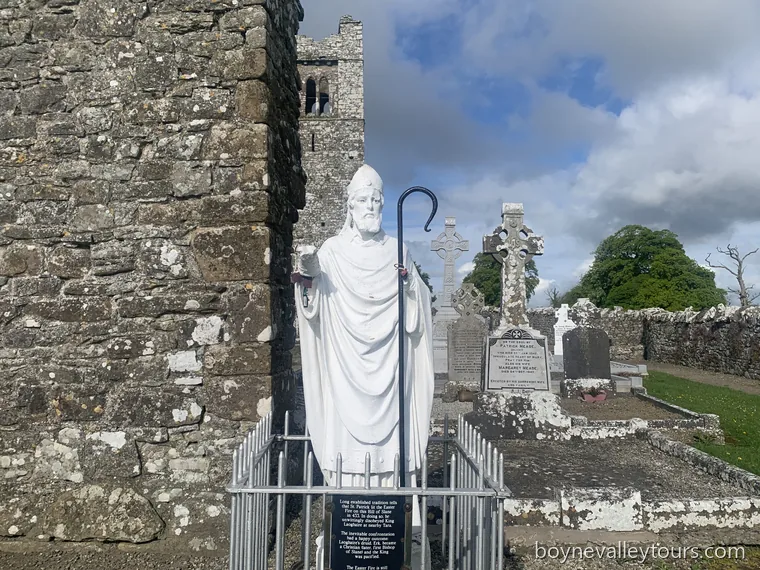 Saint Patrick | Hill of Slane, traditionally linked with the Paschal fire of AD 433
The Hill of Slane
The Hill of Slane is one of the most historically layered sites in the Boyne Valley, combining early Christian tradition, medieval monastic life, and commanding views over the River Boyne. Rising above the village of Slane in County Meath, the hill has been a place of religious importance for more than fifteen centuries.
A landscape of belief and power
Its elevated position made the Hill of Slane a natural focal point in the surrounding landscape, offering visibility across the Boyne corridor and towards other significant centers such as the Hill of Tara. This commanding setting helped establish the hill as both a symbolic and practical location for religious activity from an early date.
Saint Patrick and the Paschal fire
Early Christian tradition strongly associates the Hill of Slane with Saint Patrick. According to medieval sources, Patrick is said to have lit the Paschal fire here around AD 433, openly challenging the authority of the High King by lighting his fire before the royal festival fire at Tara. While the account is legendary in character, it reflects the hill’s early importance in the spread of Christianity in Ireland.
An early monastic foundation
The hill is traditionally linked with Saint Erc of Slane, an early Irish saint who is credited with establishing a monastic community on the site. From this early period, Slane developed as a center of Christian worship and learning, forming part of the wider network of early monasteries that shaped medieval Ireland.
Centuries of continuous religious use
Historical evidence suggests that religious activity continued on the Hill of Slane from the early medieval period through to the later Middle Ages. This continuity makes the site particularly valuable, as it reflects changing forms of monastic life over time rather than a single phase of occupation.
The Franciscan friary of the 16th century
The most substantial surviving remains belong to a Franciscan friary founded in 1512 by Sir Christopher Fleming, Lord of Slane. This late medieval foundation represents a revival of religious life on the hill during the final decades before the Dissolution of the Monasteries.
A purpose-built religious college
The Franciscan complex included a residential college designed to house a carefully defined community consisting of four priests, four lay brothers, and four choristers. This structured arrangement reflects the organized nature of late medieval religious institutions and their emphasis on education and liturgical practice.
Layout and surviving architecture
The friary buildings were arranged around a central quadrangle, with domestic ranges, service areas, and the church forming a compact enclosure. Architectural features such as staircases, fireplaces, window openings, and garderobes are still visible, providing insight into everyday life within the community.
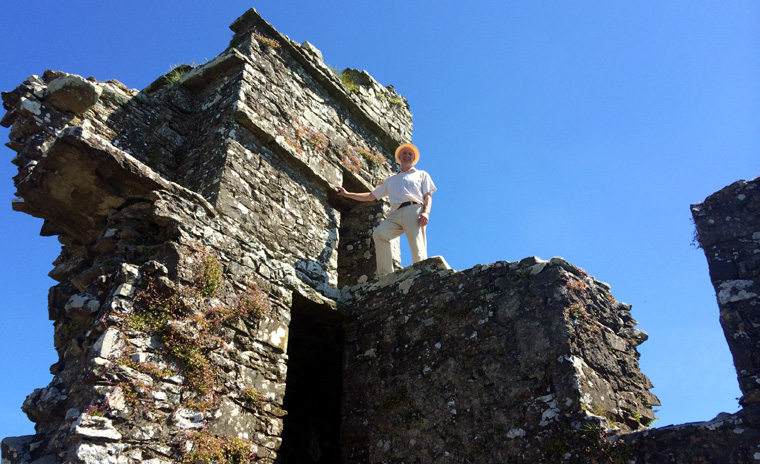 Hill of Slane | Ruins of a Franciscan College dating from 1512
The church and west tower
One of the most striking elements of the site is the tall west tower attached to the friary church. Rising above the summit of the hill, it remains a prominent landmark in the landscape and emphasises the continued importance of the site in the late medieval period.
Dissolution and later history
Like many religious houses in Ireland, the friary on the Hill of Slane was suppressed during the Dissolution of the Monasteries in the mid 16th century. Although there were later attempts to restore religious use in the 17th century, the buildings gradually fell into ruin.
The Hill of Slane today
Today, the Hill of Slane is valued as one of the most atmospheric historic sites in the Boyne Valley. Its combination of early Christian tradition, medieval architecture, and panoramic views makes it an important stop for visitors seeking to understand the religious and cultural history of the region.