Dowth in a Nutshell – 10 Key Facts
Dowth is one of the three great Neolithic passage tombs of Brú na Bóinne, built around 3200 BC on the northern edge of the Boyne bend. Less restored than Newgrange or Knowth, it still holds much of its original atmosphere and archaeological potential.
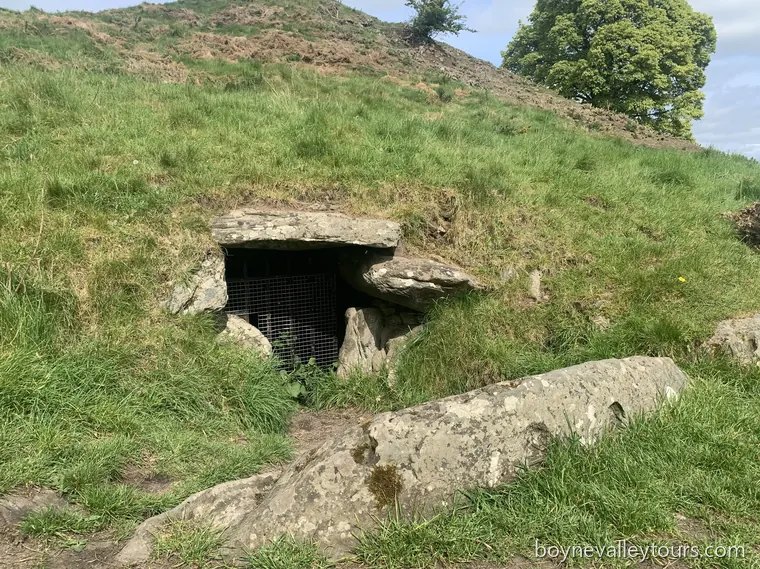 Dowth, Brú na Bóinne
- Dowth dates to around 3200 BC, placing it in the Neolithic period and making it contemporary with Newgrange and Knowth, and significantly older than Stonehenge.
- It is one of the three great passage tombs of Brú na Bóinne, forming part of a carefully planned prehistoric ceremonial landscape beside the River Boyne in County Meath.
- The mound measures approximately 85 meters in diameter, comparable in scale to Newgrange, and was originally encircled by a ring of kerbstones, some of which are decorated with megalithic art.
- Dowth contains two separate passages, both entering from the western side of the mound and leading to chambers that were originally corbelled.
- The passages are shorter and less symmetrical than those at Newgrange or Knowth, suggesting variation in design rather than a single standardized plan.
- Dowth is associated with the winter period of the solar year, with the setting sun illuminating the chamber during the days around the winter solstice, though without the precise alignment seen at Newgrange.
- Light enters the chamber through a roof level opening, illuminating the interior stones rather than the chamber floor, creating a prolonged and less dramatic light effect.
- Some kerbstones are decorated with megalithic art, most notably Kerbstone 51, which features distinctive sun-like motifs and radiating designs associated with solar symbolism rather than a wide range of abstract patterns.
- Dowth suffered extensive damage in later centuries, including large-scale stone robbing and unauthorized digging in the early modern and nineteenth century periods, which left a substantial crater-like hollow in the center of the mound and severely disturbed the monument.
- Unlike Newgrange and Knowth, Dowth has never been fully excavated or restored, leaving much of the monument archaeologically intact and preserving its potential for future research within the Brú na Bóinne UNESCO World Heritage Site, designated in 1993.
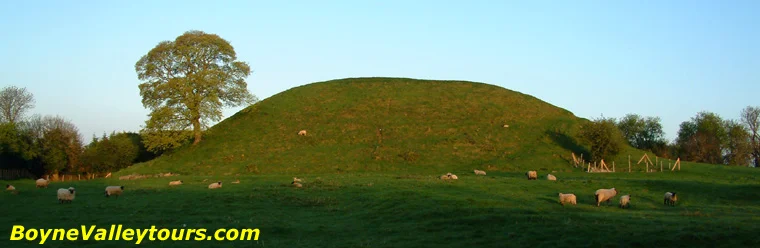 Dowth Stone Age Passage Tomb
Dowth: The Most Enigmatic Monument at Brú na Bóinne
Dowth is the least understood of the three great Neolithic passage tombs at Brú na Bóinne, yet it may be the most enigmatic. Built around 3200 BC, at the same time as Newgrange and Knowth, Dowth occupies a prominent position on the northern edge of the great bend in the River Boyne. While its neighboring monuments have been extensively excavated and interpreted, Dowth has remained comparatively under-explored, preserving an atmosphere of mystery that continues to challenge archaeologists.
Construction and Setting
Dowth consists of a large earthen mound measuring approximately 85 meters in diameter, originally encircled by a ring of kerbstones, some of which bear megalithic art. As with the other monuments in the complex, its construction required a high degree of planning, organization, and labor, drawing on both locally sourced stone and materials brought from further afield.
The mound overlooks the Boyne floodplain and commands broad views across the surrounding landscape. This commanding position suggests that visibility, landscape setting, and connection to the wider environment were central considerations for its builders, reinforcing Dowth’s role within a deliberately structured ceremonial landscape rather than as an isolated tomb.
The Passages and Chambers
Dowth contains two separate passages located on the western side of the mound, both leading into chambers that were originally corbelled. Due to later disturbance and structural instability, parts of the original roofing collapsed and modern reinforcement, including concrete, was introduced to stabilise at least one chamber. As a result, the original Neolithic roof structure is no longer fully visible today.
The passages at Dowth are shorter and less symmetrical than those at Newgrange or Knowth. This variation in design suggests that there was no single standardized architectural plan for the Boyne Valley monuments, but rather a range of solutions adapted to different symbolic or practical purposes.
Light and the Winter Sun
Dowth is closely associated with the winter period of the solar year. Rather than displaying a precise single day alignment, the monument allows low winter sunlight to enter the chamber during the days around the winter solstice, most notably at sunset. Light enters at a higher level, illuminating interior stones rather than the chamber floor.
This effect is more prolonged and less dramatic than the sunrise illumination at Newgrange. It suggests a different approach to marking seasonal change, one that may have focused on the gradual return of light during the darkest time of the year rather than a single, highly controlled moment.
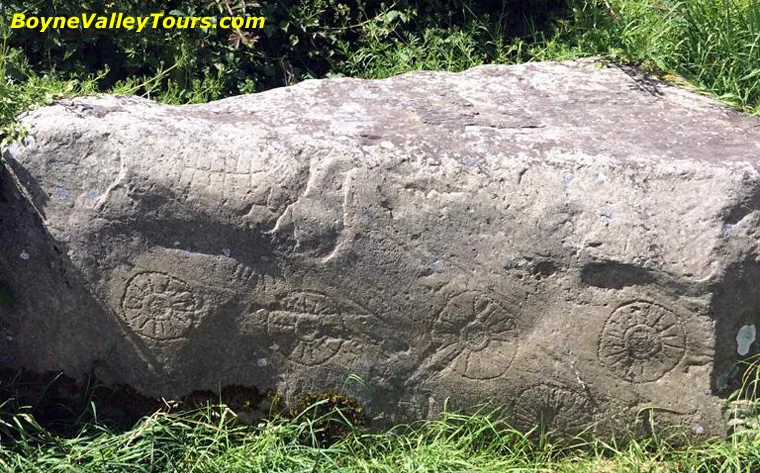 Dowth Kerbstone 51 - The Stone of the Seven Suns
Megalithic Art at Dowth
Megalithic art at Dowth is more limited than at Knowth, but remains significant. The most notable example appears on Kerbstone 51, which features distinctive sun-like symbols and radiating motifs that are widely interpreted as having a solar association.
Unlike the broad range of abstract designs found elsewhere in the Boyne Valley, the imagery at Dowth appears more focused in character. As with all Neolithic art, its precise meaning remains uncertain, but its placement and symbolism reinforce the monument’s connection with the movement of the sun and seasonal cycles.
Later History and Damage
Dowth suffered extensive damage in later centuries. Stone robbing, quarrying, and unauthorized digging during the early modern and nineteenth century periods caused severe disturbance to the monument, leaving a large crater-like hollow in the center of the mound and significantly altering its original form.
This damage obscured much archaeological evidence and complicates modern interpretation. However, large portions of the monument remain intact beneath the surface, and Dowth retains considerable archaeological potential despite the losses it has suffered.
Dowth in the Brú na Bóinne Landscape
Dowth forms an essential component of the Brú na Bóinne World Heritage Site, designated in 1993. Together with Newgrange and Knowth, it demonstrates that Neolithic communities in the Boyne Valley were creating an integrated ceremonial landscape rather than a single dominant monument.
The differences between the three great tombs suggest that each fulfilled a distinct role. Dowth’s association with the winter period, its architectural variation, and its later history point to a complementary function within the wider ritual landscape.
Dowth Today
There is no public access to the interior of Dowth, and the monument has not been restored in the manner of Newgrange or Knowth. This absence of reconstruction allows Dowth to retain a raw and powerful presence within the landscape, shaped as much by its long history of use and damage as by its Neolithic origins. The mound can be seen from the public road without a Brú na Bóinne ticket. The chambers stay closed except on rare OPW openings around the winter solstice sunset.
For those willing to look beyond the more familiar monuments, Dowth offers a quieter but deeply compelling insight into prehistoric Ireland. It stands as a reminder that much of Brú na Bóinne’s story remains incomplete, preserved beneath grass, stone, and time.