Knowth in a Nutshell – 10 Key Facts
Knowth is the largest passage tomb at Brú na Bóinne in County Meath, built around 3200 BC and surrounded by smaller satellite tombs. It is renowned for its extraordinary collection of megalithic art carved on the kerbstones that encircle the great mound.
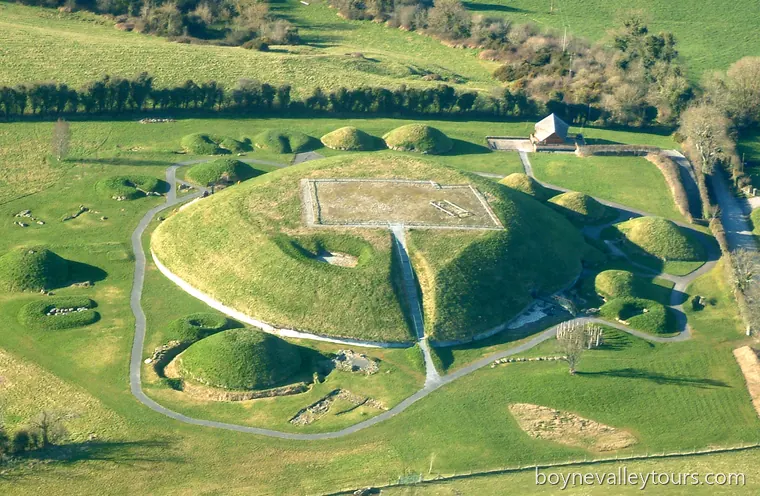 Knowth, Brú na Bóinne
- Knowth dates to around 3200 BC, placing it firmly in the Neolithic period and making it contemporary with Newgrange and significantly older than Stonehenge.
- It is the largest of the three main passage tombs at Brú na Bóinne, with a mound about 10 meters (33 feet) high and 95 meters (312 feet) across at its widest point, covering about 0.6 hectares (1.5 acres), making it one of the biggest passage tombs in Europe.
- Knowth contains two long passages, one entering from the west and the other from the east, a rare feature among Irish passage tombs.
- The eastern passage and chamber extend over 40 meters (131 feet), while the western passage and chamber extend over 34 meters (112 feet).
- Unlike Newgrange, Knowth is not aligned with the winter solstice; instead, the equinoxes appear to play a role, with sunlight reaching the ends of the passages around the spring and autumn equinoxes, though in a more diffuse and less dramatic way.
- The monument is famous for its extraordinary concentration of megalithic art, with over one third of all known megalithic art in Western Europe found at Knowth.
- Much of the art is carved on the kerbstones, featuring spirals, lozenges, chevrons, serpentine lines, and geometric motifs, many of which are hidden from view beneath the mound.
- Excavations revealed cremated and unburnt human remains, stone basins, and ceremonial objects, confirming that Knowth had both funerary and ritual functions.
- Knowth was reused for thousands of years after its construction, serving at various times as a Bronze Age burial site, an early medieval settlement, and later a Norman motte.
- Major excavations were carried out between 1962 and 1968 under the direction of Professor George Eogan, whose work was central to understanding Knowth and the wider Brú na Bóinne landscape, later designated a UNESCO World Heritage Site in 1993.
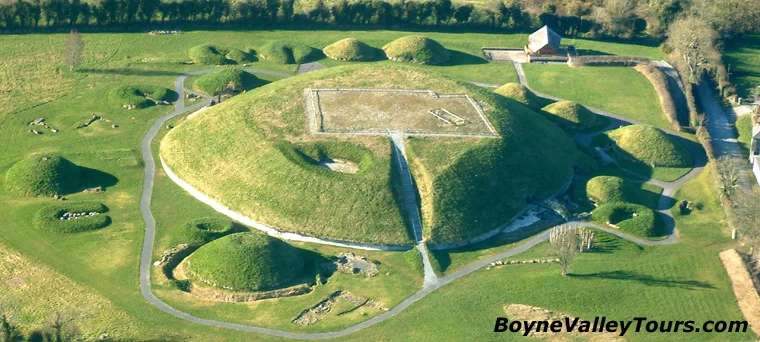 Knowth Stone Age Passage Tomb
Knowth: The Often Overlooked Giant of Brú na Bóinne
When people think of Brú na Bóinne, Newgrange usually takes center stage. Yet just a short distance away stands Knowth, a monument that is larger, more complex, and arguably richer in archaeological detail. Knowth is not simply a companion to Newgrange but a central monument in its own right, offering deep insights into Neolithic life, ritual, and artistic expression in Ireland over 5,000 years ago.
Construction and Scale
Knowth was built around 3200 BC during the Neolithic period, around the same time as Newgrange and Dowth. The main mound is about 10 meters (33 feet) high and 95 meters (312 feet) across at its widest point, covering about 0.6 hectares (1.5 acres), making it the largest of the three great passage tombs in the Brú na Bóinne complex. It is encircled by 127 kerbstones, many of which are elaborately decorated with megalithic art.
Surrounding the main mound are 19 smaller satellite tombs, forming a tightly organized ceremonial landscape. This clustering suggests Knowth was a focal point for ritual activity over many generations rather than an isolated monument.
The Twin Passages
One of Knowth’s most distinctive features is its two long passages, one entering from the west and the other from the east. This is extremely rare in Irish passage tombs. The western passage is approximately 32 meters long, with the passage and chamber together extending over 34 meters.
Both passages lead to separate chambers, each containing stone basins used to hold cremated human remains. The presence of two passages has prompted extensive discussion about their symbolic meaning, possibly reflecting ideas of balance, duality, or cyclical time within Neolithic belief systems.
Light, Time, and the Equinoxes
Unlike Newgrange, Knowth is not aligned with the winter solstice sunrise. Research has suggested a possible relationship with the equinoxes, but any alignment is far less precise and remains the subject of debate. Around the spring and autumn equinoxes, sunlight can reach deep into the passages, though the illumination is weak, indirect, and does not produce a clear focal effect within the chambers.
Rather than a carefully engineered solar event, this subtle light penetration may reflect a broader interest in seasonal balance or transition. The contrast with the highly controlled solstice alignment at Newgrange suggests that Knowth may have served a different ceremonial role within the Brú na Bóinne landscape, pointing to a varied and nuanced understanding of time, light, and ritual in the Neolithic period.
Megalithic Art on an Unmatched Scale
Knowth is internationally renowned for its extraordinary concentration of megalithic art. Over one third of all known megalithic art in Western Europe is found here. Much of it is carved on the kerbstones, with additional decoration on stones within the passages and chambers.
The carvings include spirals, lozenges, chevrons, zigzags, arcs, and sinuous lines. While only a small number of kerbstones at Newgrange display extensive decoration, a far greater proportion of the kerbstones at Knowth are richly carved. Much of this artwork is positioned around the base of the mound or partially concealed beneath it, suggesting that the carvings were not intended for casual viewing but formed part of a more restricted or ritualized visual language.
Excavations and Archaeological Discoveries
Major excavations at Knowth were carried out between 1962 and 1968 under the direction of Professor George Eogan of University College Dublin. These excavations revealed cremated and unburnt human remains, stone basins, worked flint, and other artifacts, confirming that Knowth functioned as both a burial monument and a ceremonial space.
The excavations also showed that Knowth was reused repeatedly over thousands of years. Evidence points to Bronze Age burials, early medieval settlement including souterrains and houses, and later Norman activity when the mound was adapted as a motte.
Knowth Through Time
Few monuments in Ireland display such a long and continuous sequence of use. From its origins as a Neolithic passage tomb, Knowth evolved into a medieval settlement and defensive structure. This layering reflects the enduring importance of the site within the Boyne Valley landscape.
Its continued reuse helped preserve much of the monument, even as its original meaning shifted. Knowth remained a place associated with authority, memory, and power long after its Neolithic builders were gone.
Knowth Today
Today, Knowth forms part of the Brú na Bóinne UNESCO World Heritage Site, designated in 1993 in recognition of its outstanding universal value. There is no public access to the passages at Knowth, but the mound, its carved kerbstones, and the surrounding landscape continue to convey a strong sense of scale, complexity, and enduring presence.
Access is by guided tour only. Timed tickets have to be booked in advance at the Brú na Bóinne Visitor Center, because daily numbers are limited and popular dates sell out. On a private day tour we arrange the tickets when Knowth is part of the itinerary.
For visitors willing to look beyond the fame of Newgrange, Knowth offers a deeper and more complex story. It stands as a monument of scale, artistry, and longevity, bearing witness to the ingenuity and beliefs of Ireland’s Neolithic communities.