Monasterboice in a Nutshell: 10 Key Facts
Monasterboice is an early Christian monastic site in County Louth, founded by Saint Buite and famed for its high crosses and round tower. Muiredach's Cross, in particular, is one of Ireland's finest surviving examples of early medieval stone carving.
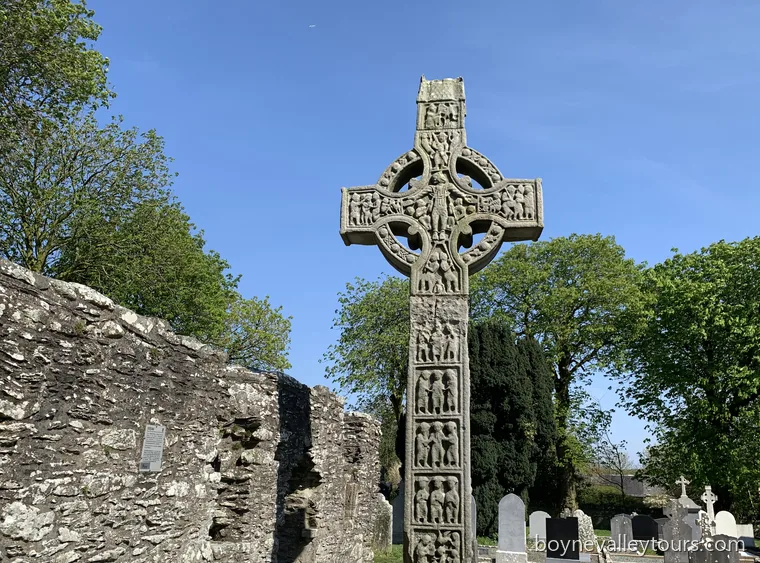 Monasterboice, County Louth
- Founded in the early Christian period. Monasterboice is an early Christian settlement associated with Saint Buite, known for its round tower and high crosses.
- An important monastic settlement. The monastery grew into a major center of religion, learning, and craftsmanship during early medieval Ireland.
- Home to three remarkable high crosses. Monasterboice is best known for its three stone high crosses, among the finest examples of early medieval sculpture in Ireland.
- Muiredach’s Cross is the most famous. Muiredach’s Cross, dating to around the early 10th century, is considered the finest high cross in Ireland due to its detailed biblical carvings.
- Scenes from the Bible carved in stone. The panels on the crosses depict scenes from the Old and New Testaments, designed to teach biblical stories to a largely illiterate population.
- A round tower formed part of the monastery. The round tower at Monasterboice originally had a conical cap and served as a landmark, bell tower, and place of refuge for the monastic community.
- A medieval graveyard still in use. The graveyard at Monasterboice has been used for burial for over a thousand years and continues to serve the local community.
- Decline after the rise of Mellifont. The importance of Monasterboice declined in the 12th century following the foundation of nearby Mellifont Abbey.
- Survived Viking and later turmoil. Like many early monasteries, Monasterboice experienced periods of attack and disruption during the Viking Age.
- One of Ireland’s finest early Christian sites. Today, Monasterboice is regarded as one of the most important early Christian monastic sites in Ireland and a highlight of the Boyne Valley.
Monasterboice High Crosses
Monasterboice is an early Christian settlement associated with Saint Buite, known for its round tower and high crosses.
Muiredach's Cross 10th Century 5.5m (18 ft)
Eastern face:
• Adam and Eve.
• Cain murdering Abel.
• David and Goliath.
• Moses bringing water from the rock to the Israelites.
• Three Magi bearing gifts to Mary and Jesus.
• Last Judgment.
• The saved on Christ's right.
• Devil holding a trident.
• St. Anthony and St. Paul - 3rd century hermit saints.
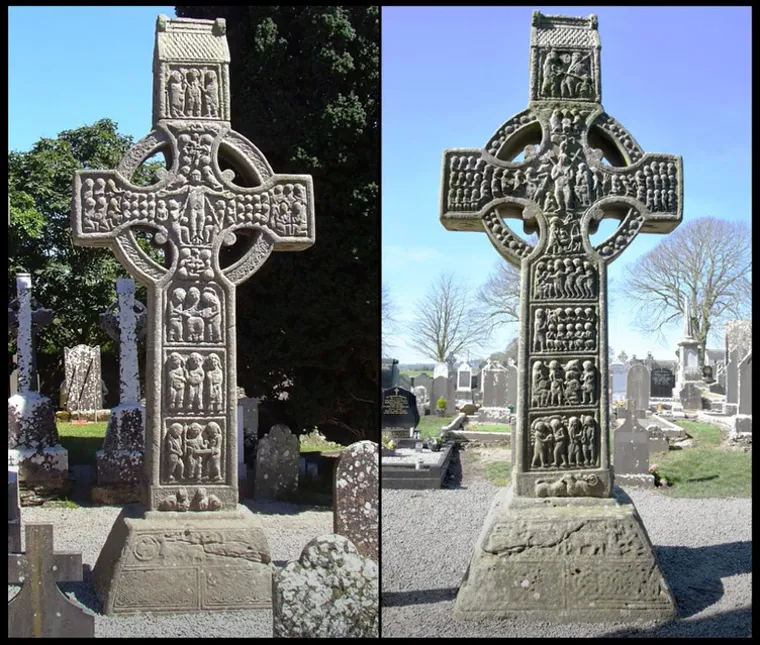 Muiredach's Cross 10th Century | Monasterboice
Western face:
• An inscription translated as, "A prayer for Muiredach for whom the cross was made" accompanied by two cats.
• The arrest of Christ.
• Doubting Thomas.
• Christ giving the keys of heaven to St. Peter and a book to St. Paul.
• Crucifixion scene in the center.
• (Left Arm) Peter denying Christ.
• (Right Arm) The Resurrection of Christ.
• Moses praying with Aaron and Hur.
West Cross 10th century 6.5m high (21 ft)
Eastern face:
• David killing a lion.
• Abraham sacrificing Isaac.
• Worship of the Golden Calf.
• David with Goliath's head - Samuel anoints David as King.
• Goliath defying the Armies of Israel.
• Horse drawing chariot - Elijah setting forth on his heavenward journey.
• The three holy Children in the Babylonian Furnace.
• The Ascension, Christ with eleven Apostles.
• The Apparition of the Risen Christ – Head of Cross.
• (Left Arm) The Arrest of Christ in Gethsemane.
• (Right Arm) Michael the Archangel drives a crozier into Satan.
Western face:
• The Resurrection.
• The Baptism of Christ.
• The Twelve Apostles.
• The Crucifixion.
• (Left Arm) Christ blindfolded and mocked.
• (Right Arm) The kiss of Judas.
Monasterboice was an important center of spirituality and scholarship until the Cistercians arrived at nearby Mellifont Abbey in 1142.
Irish Yew Trees at Monasterboice
The Irish yew (Taxus baccata ‘Fastigiata’) is a distinctive variety of the common yew, notable for its columnar growth profile. Discovered in 1767 on the slopes of the Cuilcagh Mountains in County Fermanagh, cuttings from the original tree became the foundation for all subsequent Irish yews. The Irish yew gained popularity in the 19th century, especially during the Victorian era, for use in formal gardens and cemeteries due to its unique shape and dark, dense foliage.
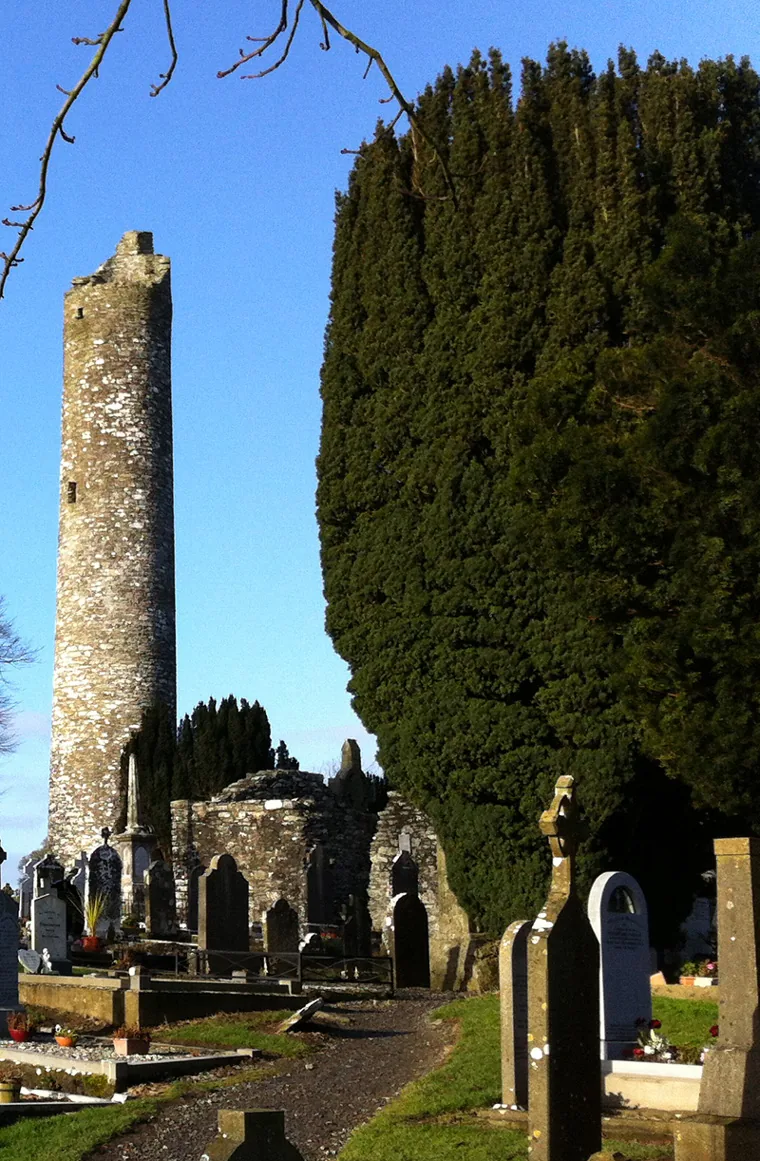 The Irish yew is a distinctive variety of the common yew, notable for its columnar growth profile
Monasterboice is free to visit. It is an active graveyard, so stay on the paths and treat the crosses and tower with care.