Duleek Abbey in a Nutshell | 10 Key Facts
Duleek Abbey is one of County Meath's most important early Christian and medieval church sites, with ruins that span early church tradition, the Viking Age and later Augustinian use. The standing tower and church walls still dominate the historic graveyard at the heart of the town.
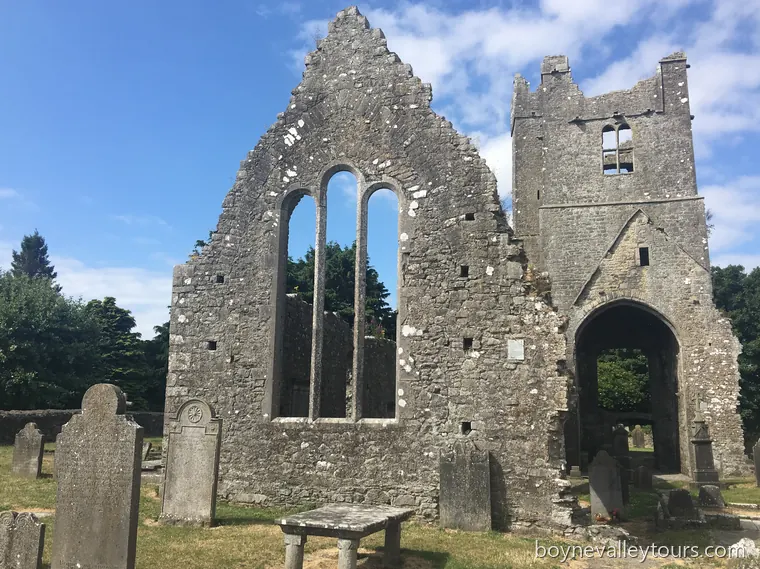 Duleek Abbey, County Meath
Here are ten key facts to help you understand what you are seeing on site.
- Duleek’s name means “House of Stone”. The name comes from the Irish Damhliag, traditionally linked with an early stone church at Duleek.
- Tradition connects the site with Saint Patrick and St Cianán. Early tradition holds that Saint Patrick established a bishopric at Duleek and placed it in the care of St Cianán.
- The medieval monastery is known as St Mary’s Abbey. The abbey is a National Monument and represents the later medieval phase of the church site.
- The Augustinian foundation dates to the late 12th century. St Mary’s Abbey was established for Canons Regular on a grant by Hugh de Lacy, Lord of Meath.
- Duleek was targeted during the Viking Age. Historical sources record attacks, including a Viking sack in the 9th century and later plundering in the 12th century.
- A round tower once stood here, but it is gone. Although the round tower no longer survives, a clear “scar” or negative impression remains visible on the north wall of the later tower.
- The standing tower reflects late medieval and post-medieval building. The surviving belfry and tower elements date mainly to the 15th and 16th centuries, showing how the complex evolved over time.
- Two important high crosses survive in the graveyard. The North and South Cross are generally dated to around the 10th century and are key survivals from the early medieval settlement.
- The interior preserves notable tombs and memorials. These include the effigial tomb of James Cusack, Catholic Bishop of Meath (1679 to 1688), and memorials associated with the Bellew family.
- The 19th-century Church of Ireland church marked the later phase of worship at the site. St Cianán’s Church was built in 1816 and has since been adapted for new use. The building now operates as Tribe Restaurant.
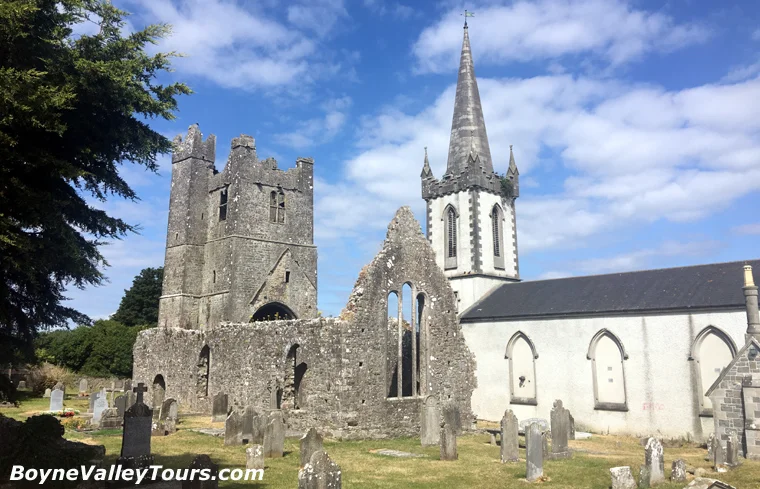 Duleek Abbey and Saint Cianán’s Church
Duleek Abbey – An Early Christian and Medieval Church Site
Duleek Abbey is one of the most historically important ecclesiastical sites in County Meath. The surviving ruins reflect more than a millennium of religious activity, beginning with an early Christian settlement and continuing through the medieval Augustinian abbey and later post-medieval use. The site illustrates the changing religious, architectural, and political landscape of Ireland from the early medieval period to the 19th century.
Early Christian Origins
The name Duleek derives from the Irish Damhliag, meaning “House of Stone”. This name is traditionally associated with an early stone church at the site, possibly dating to the 5th century, making Duleek one of the earliest places in Ireland where stone was used for church construction.
Saint Patrick and St Cianán
Early tradition holds that Saint Patrick established a bishopric at Duleek during his mission in Ireland and placed it in the care of St Cianán. While these accounts belong partly to tradition, they reflect the recognized importance of Duleek in the early Irish church.
Duleek During the Viking Age
Duleek was attacked and plundered on several occasions between the 9th and 12th centuries. Its position as a wealthy ecclesiastical center made it vulnerable to Viking raids, a pattern seen at many early church settlements throughout Ireland.
The Lost Round Tower
A round tower once formed part of the monastic complex at Duleek. Although the tower no longer survives, the scar where it joined a later structure is still visible on the north face of the standing square tower, marking the location of the earlier building.
The Augustinian Abbey of St Mary
In the 12th century, St Mary’s Abbey was established at Duleek for Augustinian Canons Regular on land granted by Hugh de Lacy, Lord of Meath. This foundation marked the transformation of the early church settlement into a formal medieval abbey under Norman patronage.
Later Medieval Buildings
Much of the surviving masonry dates from the later medieval period. The square tower, built in the 15th or 16th century, replaced the earlier round tower and reflects the defensive concerns of the time, when religious buildings often served multiple functions.
The High Crosses
Two important high crosses stand in the abbey graveyard and are generally dated to the 10th century. These crosses are key survivals from the early medieval phase of the site and provide insight into the religious art and symbolism of the period.
Post-Medieval Tombs and Memorials
Within the church ruins are several notable tombs and memorials, including the effigial tomb of James Cusack, Catholic Bishop of Meath from 1679 to 1688, and memorials associated with the Bellew family. An altar bearing the arms of the Bellew, Plunkett, Preston, and St Lawrence families reflects the influence of prominent Old English families in the region.
St Cianán’s Church of Ireland
Religious use of the site continued into the 19th century with the construction of Saint Cianán’s Church of Ireland church in 1816. This building represents the later phase of worship at Duleek and has since been repurposed for new use. Today, it operates as Tribe Restaurant.
Duleek Abbey Today
Today, Duleek Abbey remains an important historic monument, preserving evidence of more than a thousand years of religious and community life. The site allows visitors to trace the development of an early Christian settlement into a medieval abbey and beyond, within the wider historical landscape of the Boyne Valley.