Fore Abbey in a Nutshell – 10 Key Facts
Fore Abbey in County Westmeath began as an early Christian monastery founded by St Feichin and was later refounded as a Benedictine priory under Norman patronage. The surviving church, towers and cloister ruins stand in a green valley long associated with pilgrimage and local legend.
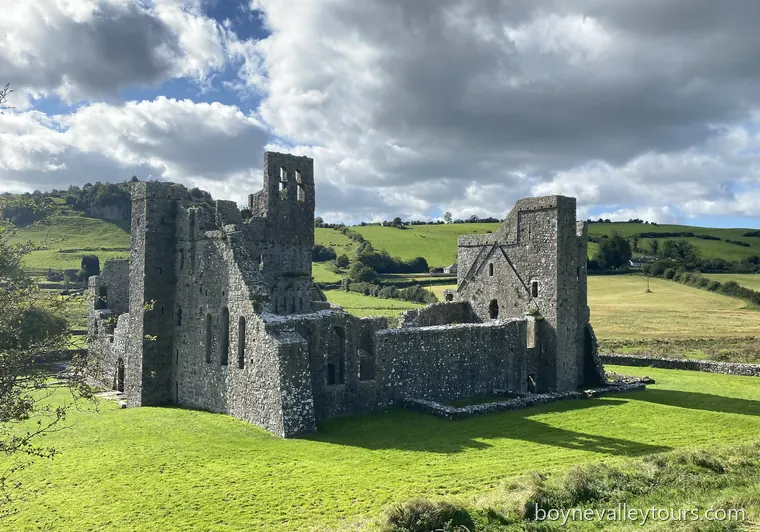 Fore Abbey, County Westmeath
- Fore Abbey was founded around AD 630 by St. Feichin, an early Irish monastic saint who established a monastery in the valley at Fore in what is now County Westmeath.
- The original monastery was part of Ireland’s early Christian monastic tradition, consisting of timber structures and simple ecclesiastical buildings that formed an important spiritual center in early medieval Ireland.
- The site became associated with the “Seven Wonders of Fore”, medieval traditions that enhanced the abbey’s reputation as a place of pilgrimage and spiritual significance.
- In the early 13th century Hugh de Lacy, the Norman Lord of Meath, refounded the site as a Benedictine priory, introducing continental monastic architecture and aligning Fore with the Anglo-Norman church structure.
- The Benedictine priory was dependent on the Abbey of St. Taurin in Évreux, Normandy, reflecting the strong Norman influence in Ireland following the 12th-century invasion.
- Much of what survives today dates from the 15th century, when the priory was rebuilt and expanded after periods of decline and damage.
- The surviving ruins include a large church, cloister, and domestic ranges, demonstrating the scale and importance of the late medieval Benedictine community at Fore.
- The abbey suffered repeated destruction and rebuilding, including attacks during medieval conflicts and suppression during the 16th-century Dissolution of the Monasteries under Henry VIII.
- After the Dissolution, the site passed into secular ownership, and parts of the structure were adapted for defensive and residential use in the post-medieval period.
- Today Fore Abbey stands as one of Ireland’s most atmospheric monastic ruins, combining early Christian origins, Norman reform, and late medieval architecture in a single layered historic landscape.
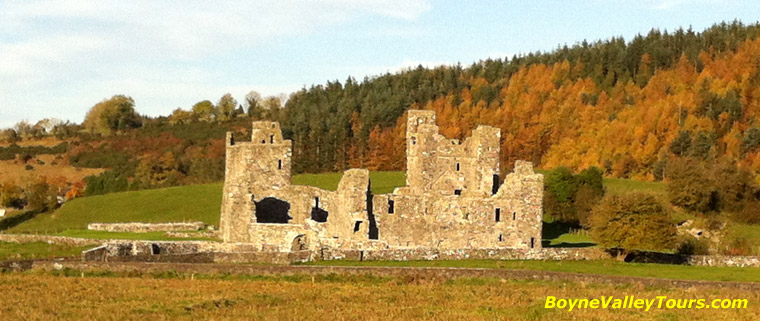 Fore Benedictine Abbey, County Westmeath
Fore Abbey: History, Legend, and the Seven Wonders
Fore Abbey is unusual in that it combines firmly documented medieval history with a rich layer of local legend. The early monastery founded by St. Feichin in the seventh century developed into an important ecclesiastical center long before the arrival of the Normans. When Hugh de Lacy refounded the site as a Benedictine priory in the early 13th century, Fore became part of a wider European monastic network, yet its older Irish identity remained embedded in local tradition.
The physical remains visible today are largely late medieval in date, but the setting in the narrow valley, with watercourses, mills, churches, and domestic ranges, reflects centuries of adaptation. Alongside this historical development grew a body of stories known collectively as the Seven Wonders of Fore, traditions that elevated the abbey’s reputation and helped sustain its identity as a place of pilgrimage.
The Seven Wonders of Fore
The monastery built upon the bog. Tradition holds that St. Feichin established his monastery on unstable ground. The story emphasises divine intervention and reinforces the idea that the foundation of the community was guided by spiritual authority rather than practical convenience.
The mill without a race. According to legend, there was no natural water source to power the mill. St. Feichin is said to have struck the ground with his crozier, causing water to spring forth and drive the mill. While the valley does contain natural water sources, the story reflects the medieval tendency to associate saints with miraculous control over nature.
The water that flows uphill. The underground movement of water near the mill appears, at certain points, to run contrary to expectation. Medieval observers interpreted this as a wonder. Modern explanation lies in the natural gradients and hydrology of the valley, yet the story endures as part of Fore’s identity.
The tree that won’t burn. An ash tree once stood near the abbey with three branches said to symbolise the Trinity. Local tradition claimed that its wood would not burn. Whether symbolic or devotional in origin, the story reflects the blending of Christian theology with local landscape features.
The water that doesn’t boil. Water from St. Feichin’s well was believed never to boil, even when placed over heat. Holy wells throughout Ireland were often attributed special properties, reinforcing the saint’s continued presence in the landscape long after his death.
The anchorite in a cell. Hermits or anchorites are said to have occupied a small stone cell at Fore, living lives of prayer and isolation. Such cells were a feature of early Irish monastic practice, and the survival of this tradition at Fore connects the site to its earliest spiritual roots.
The lintel-stone raised by St. Feichin’s prayers. A large lintel stone above the doorway of St. Feichin’s church was believed to have been lifted into place through prayer rather than physical labor. Like many medieval miracle stories, it emphasises divine assistance in the creation of sacred architecture.
History and Legend Side by Side
The Seven Wonders of Fore do not replace the historical record; instead, they sit alongside it. Archaeology and documentary sources confirm the abbey’s early foundation, Norman refoundation, and late medieval rebuilding. The legends reflect how later generations understood and interpreted the site. Together, history and folklore create a layered narrative that makes Fore Abbey one of the most distinctive monastic landscapes in Ireland.
Today, visitors can walk among the remains of the church, cloister, and domestic buildings while still sensing the deeper traditions that shaped the valley. Fore Abbey is in the care of the OPW and is free to visit. The valley paths are uneven. Fore Abbey stands not only as a medieval ruin, but as a place where memory, miracle, and monastic discipline have been intertwined for over thirteen centuries.