Kells in a Nutshell – 10 Key Facts
Kells was a major early medieval royal and monastic center in County Meath, closely associated with St Colmcille and with the Book of Kells tradition. Surviving landmarks include high crosses, a round tower and St Colmcille's House, a rare stone-roofed oratory.
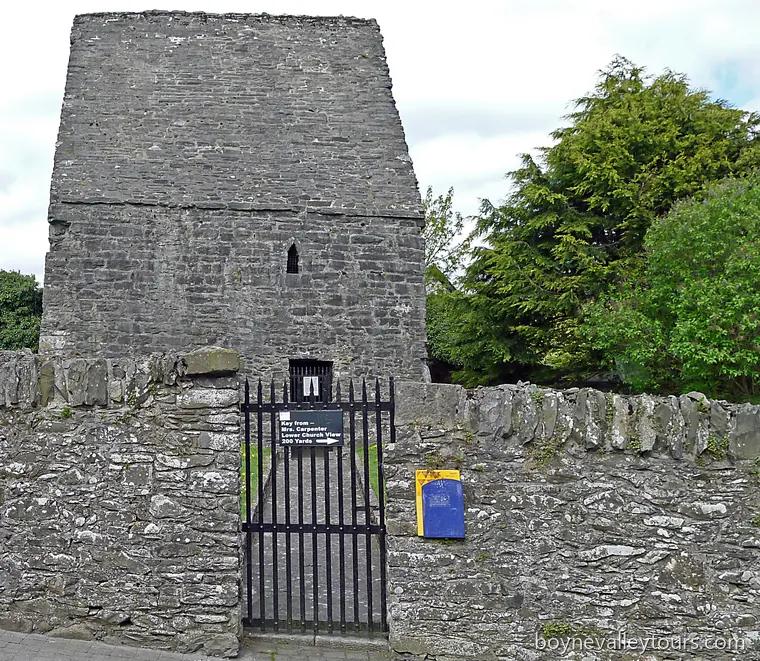 St Colmcille's House, Kells
- An ancient royal center. Kells, known in Irish as Ceanannas Mór meaning “Great Fort”, was an important royal residence in early medieval Ireland before the establishment of a monastery.
- Founded by St. Colmcille. Kells is associated with St. Colmcille (Columba), whose 6th-century monastery on Iona later gave rise to the Columban community here.
- The monks of Iona moved to Kells. In the 9th century, monks from the monastery of Iona off the west coast of Scotland relocated to Kells to escape repeated Viking raids.
- Home of the Book of Kells. The monks brought with them the illuminated manuscript known as the Book of Kells, which may have been completed at Kells. The original is now in the Library of Trinity College Dublin.
- A major monastic enclosure. The monastery at Kells developed into a large and wealthy ecclesiastical settlement, protected by earthworks and playing a key role in the religious and political life of the region.
- Remarkable high crosses. Kells is renowned for its collection of early medieval high crosses, including the Market Cross, the South Cross near the round tower, and an unfinished West Cross.
- Biblical scenes carved in stone. The panels on the crosses depict scenes from the Old and New Testaments, including the Crucifixion, Daniel in the Lions’ Den, the Sacrifice of Isaac, the Miracle of the Loaves and Fishes, and the Resurrection.
- The Market Cross. The Market Cross is one of the finest in Ireland, with richly carved panels showing Christ as King of Glory, the Fall of Man, the Anointing of David, and Noah and the Ark.
- The Spire of Lloyd. The Spire of Lloyd is a distinctive inland lighthouse folly built in 1791 by Thomas Taylor of Headfort House in memory of his father, rising approximately 30 meters (100 feet) above the surrounding countryside.
- A layered historic landscape. Today, Kells combines its early Christian heritage, exceptional stone sculpture, medieval remains, and later landmarks such as the Spire of Lloyd, making it one of the most historically rich towns in County Meath.
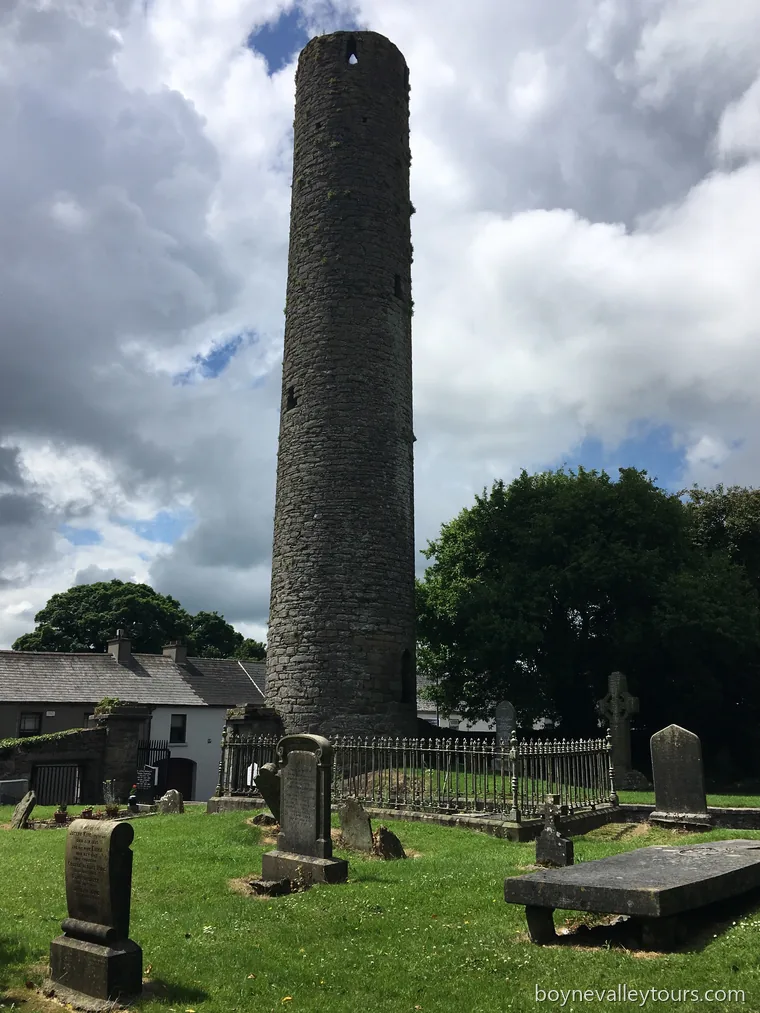 Kells Round Tower | Early medieval monastic landmark
Kells Monastic Heritage and Landmarks
The monastic enclosure and the shape of the town
Kells developed around a major early medieval monastery, and the scale of that settlement is still visible in the layout of the modern town. The monastic precinct was defined by enclosing earthen banks, and later urban development followed these curving lines. As a result, the street pattern of Kells preserves the footprint of the early ecclesiastical center and reflects the town’s origins as a monastic settlement.
The round tower
The round tower at Kells is one of the most prominent surviving elements of the monastic site. Like other Irish round towers, it combined symbolic and practical functions, including storage, status, and refuge in times of danger. The tower has a raised doorway and multiple internal floors. Its conical cap no longer survives, and the upper stage is notable for having five openings rather than the more usual four.
St Colmcille’s House
St Colmcille’s House is a rare surviving stone oratory, generally dated to the 9th or 10th century. Its steeply pitched stone roof and barrel-vaulted interior make it one of the most distinctive early medieval buildings in Ireland. Local tradition associates the building with the safeguarding of important relics connected to St Colmcille and the Columban community.
High crosses and the idea of sanctuary
Kells is exceptional for the number and quality of its high crosses, which once stood within and around the monastic enclosure. These monuments combine biblical storytelling with statements of authority and patronage. Their presence is also linked to the concept of sanctuary, marking the sacred space of the monastery and its protection under ecclesiastical law.
The Book of Kells and the Columban tradition
Kells is closely associated with the Columban tradition and with the relocation of monks from Iona during the Viking Age. The Book of Kells is a Latin Gospel manuscript produced within this cultural world. While its exact place of origin is debated, Kells played a central role in the manuscript’s early history and long-term legacy. The original book is kept at Trinity College Dublin. A facsimile can be seen in Kells.
The Spire of Lloyd
On high ground just outside the town stands the Spire of Lloyd, an 18th-century landmark that adds a later layer to the Kells landscape. Built in 1791 as a memorial by the local landlord, it takes the form of an inland lighthouse folly and rises prominently above the surrounding countryside, offering views across the region.
Kells High Crosses
The Market Cross
Eastern face:
- Four horsemen carrying swords and shields (Base)
- Christ in the Sepulchre: the Resurrection
- Christ as King of Glory
- The Fall of Man, the Death of Abel
- The Anointing of David (Head - below center)
- Daniel in the Den of Lions (Head - center)
- The sacrifice of Isaac (Left Arm)
Western face:
- Noah driving the animals into the ark (Base)
- The Miracle at Cana
- The Miracle of the Loaves and Fishes
- The Crucifixion (Head - center)
South Cross (at Round Tower)
Eastern face:
- Noah driving the animals into the Ark (Base)
- The Fall of Man, the Death of Abel
- The Holy Children in the Furnace
- Daniel in the Den of Lions
- The Sacrifice of Isaac (Left Arm)
- Saints Paul and Anthony in the Desert (Right Arm)
- The Miracle of the Loaves and Fishes (Top Shaft)
Western face:
- Two horsemen ride before a chariot (Base)
- The Crucifixion
- Christ in Majesty with symbols of the four Evangelists
West Cross (Broken)
Facing Church:
- Baptism of Christ
- Miracle at Cana
- Presentation in the Temple
- David Harpist
- Entry into Jerusalem
Facing wall:
- Adam and Eve
- Noah's Ark
The high crosses, round tower, and monastic enclosure are free to visit outdoors. St Colmcille’s House has limited opening. The Book of Kells itself is in Dublin.