Tlachtga (Hill of Ward) in a Nutshell – 10 Key Facts
Tlachtga, the Hill of Ward near Athboy, is a ceremonial hill long linked with seasonal ritual and the traditions of Samhain. Its rare multi-ringed earthwork still crowns the summit overlooking the plains of Meath.
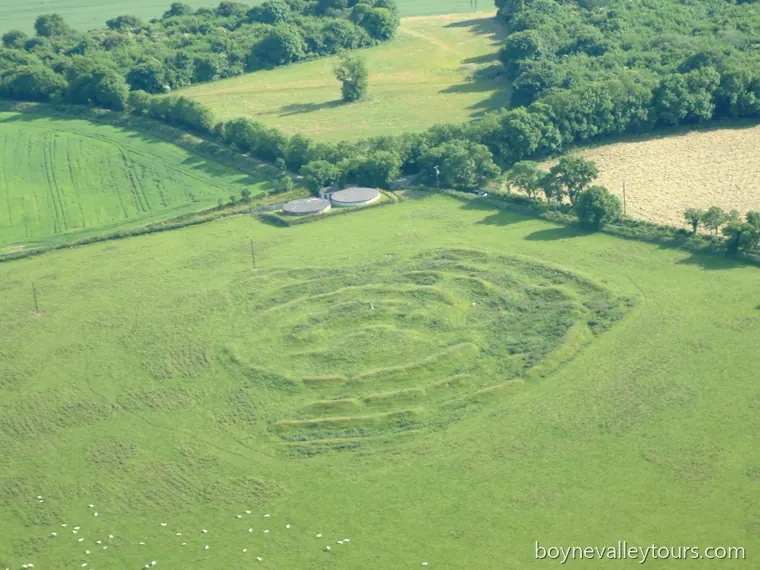 Tlachtga, Hill of Ward
- Tlachtga (Tlachta) is the Irish name for the Hill of Ward, a prominent ceremonial hill near Athboy, County Meath, long associated with large-scale gatherings and seasonal ritual in the ancient kingdom of Mide.
- The summit is enclosed by a rare quadrivallate earthwork, meaning four concentric banks with ditches between them, forming a circular enclosure measuring approximately 140 to 150 meters (460 to 490 feet) in diameter.
- Geophysical survey and excavation have revealed a more complex landscape, including evidence of earlier and possibly larger enclosure elements beneath or around the visible earthworks, as well as a smaller enclosure to the south.
- The monument developed in multiple phases, rather than being built all at once, indicating that the hill was remodelled and reused over an extended period.
- Archaeological evidence points to episodes of intense burning, including substantial charcoal deposits and traces of burned structural material, suggesting that fire played a central role in activities on the hill.
- In medieval Irish tradition, Tlachtga is one of the great Samhain fire sites, where a ceremonial New Year fire was said to be lit at the beginning of winter.
- Samhain marks the beginning of November, with observances traditionally starting on the evening before, signalling the end of the old year and the beginning of winter in the early Irish calendar. The festival later influenced Halloween customs.
- The hill is named for Tlachtga, a powerful druidess in Irish mythology, described in medieval literature as the daughter of the druid Mug Ruith, who is associated with learning and magical knowledge.
- According to legend, Tlachtga traveled abroad with her father, returned to Ireland, gave birth to three sons, and died on the hill, after which the site took her name. These accounts belong to mythological tradition rather than documented history.
- Local tradition links the hill with Oliver Cromwell’s 1649 campaign in County Meath, and it is sometimes said that troops camped here and damaged the earthworks. While fighting took place in the wider area, direct archaeological evidence confirming damage by Cromwell’s army has not been conclusively established.
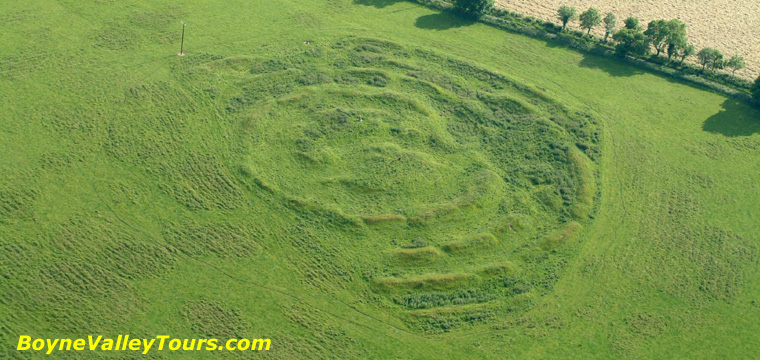 Tlachtga - Hill of Ward
Tlachtga (Hill of Ward): Archaeology, Myth and the Fires of Samhain
Tlachtga, better known today as the Hill of Ward near Athboy, County Meath, is one of the most intriguing ceremonial sites in Ireland. Set within the wider royal landscape of ancient Mide, and not far from the Hill of Tara, the site blends archaeology, medieval legend, and living seasonal tradition.
The Quadrivallate Earthwork
The most visible feature on the summit is a large quadrivallate enclosure, meaning it is defined by four concentric banks with ditches between them. The enclosure measures roughly 140 to 150 meters (460 to 490 feet) in diameter, forming an impressive circular monument that dominates the hilltop. Geophysical survey and excavation suggest that what survives today represents only part of a more complex ceremonial landscape, with earlier phases and additional enclosures identified nearby.
Fire and Ceremony on the Hill
Archaeological investigations have revealed evidence of burning episodes on the hill, including charcoal-rich deposits and traces of burned structural material. These findings support long-standing traditions that associate Tlachtga with ritual fire ceremonies. Although the exact form and date of each phase of activity remain under study, fire clearly played a central role in how the site functioned.
Tlachtga and the Festival of Samhain
In medieval Irish tradition, Tlachtga is one of the great fire sites of Samhain. Samhain falls at the beginning of November, with celebrations traditionally starting on the evening of 31 October. It marked the end of the old year and the beginning of winter in the early Irish calendar, a liminal moment when boundaries between worlds were believed to be thin.
According to later tradition, a ceremonial New Year fire was lit on Tlachtga after sunset. From this sacred flame, torches were carried to other important hills in the region, often said to include Tara, symbolically spreading renewal across the kingdom.
The Myth of Tlachtga
The hill takes its name from Tlachtga, a powerful druidess in Irish mythology. She is described in medieval literature as the daughter of the druid Mug Ruith. Some accounts tell how she traveled with her father to Italy, where they studied with the sorcerer Simon Magus. The stories then recount that she suffered violence abroad, returned to Ireland, gave birth to three sons named Dorb, Cuma and Muacth, and died soon after.
Legend holds that she was buried on the hill which thereafter bore her name. These accounts belong to mythological tradition rather than documented history, but they reflect the perceived sacred power of the site in early storytelling.
Sacred Space and Later Folklore
Tradition suggests that in pre-Christian times the summit was regarded as sacred ground, open only to druids except during Samhain, when the wider community gathered for seasonal rites. Such descriptions come from medieval literary sources and later folklore, and should be understood as part of Ireland’s mythic heritage rather than literal historical record.
Local tradition also links the hill with Oliver Cromwell’s 1649 campaign in County Meath. It is often said that Parliamentary troops camped on or near the summit and caused damage to the earthworks. While military activity certainly occurred in the region at that time, direct archaeological proof that visible damage to the enclosure can be attributed specifically to Cromwell’s army has not been conclusively established.
Today, Tlachtga remains strongly associated with Samhain and the origins of Halloween. Modern cultural events continue to echo the hill’s ancient reputation as a place of fire, transition, and gathering at the turning of the year.
The hill is an open earthwork with no visitor building. Paths can be uneven, and parking nearby is limited.