Trim Castle in a Nutshell: 10 Key Facts
Trim Castle is the largest Anglo-Norman castle in Ireland, built beside a strategic ford on the River Boyne in County Meath. Its massive cruciform keep and curtain walls still dominate the heritage town of Trim, later used as a filming location for Braveheart.
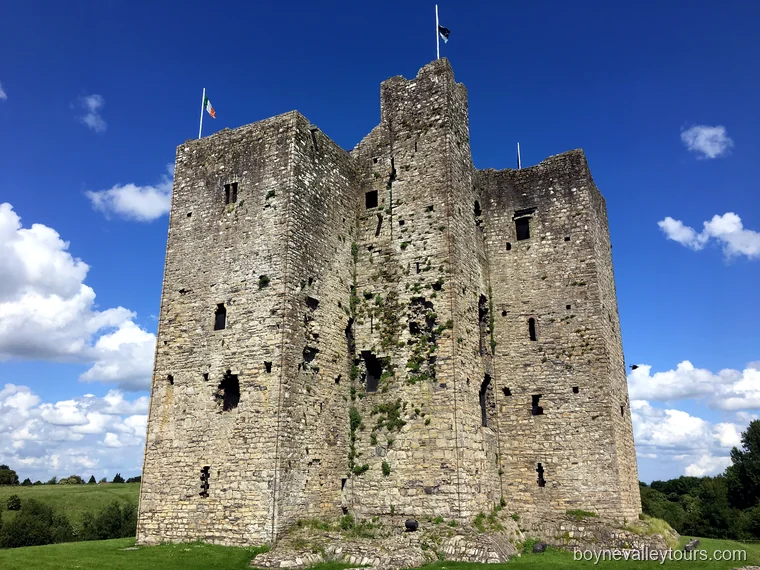 Trim Castle, County Meath
- Ireland’s largest Anglo-Norman castle. Trim Castle is the largest and one of the best-preserved Anglo-Norman fortresses in Ireland, set on the south bank of the River Boyne.
- Founded after the grant of Meath in 1172. King Henry II granted Hugh de Lacy the Liberty of Meath in 1172, and de Lacy chose Trim as the center of his new lordship.
- A timber ringwork came first. De Lacy’s first stronghold was a timber fort behind earth banks. In 1174 it was captured and burned by Ruaidrí Ua Conchobair (Rory O’Connor), the last High King of Ireland.
- Stone building began in the mid 1170s. Work on a permanent stone castle followed. Hugh de Lacy and later his son Walter raised the great keep and curtain walls; Walter added an extra story after inheriting the castle.
- A rare twenty-sided cruciform keep. The central fortification is a monumental three-story keep with a unique twenty-sided, cruciform plan and walls about 3 meters (10 feet) thick. All of the projecting towers survive except the northern one.
- Curtain wall, ditch and moat. The keep was protected by a ditch, curtain wall and water-filled moat, enclosing an area of about 1.2 hectares (3 acres) within the defended enclosure.
- Largely complete by about 1220. Most of the castle visible today was finished by around 1220, leaving an unusually clear example of early Norman military architecture.
- Later known as King John’s Castle. The fortress is often called King John’s Castle, though when King John visited Trim he preferred to stay in a tent across the river.
- Free grounds, guided keep access. Visitors may walk around the castle grounds free of charge. Access to the keep is only on a guided tour with the onsite OPW guides.
- A Braveheart film location. Mel Gibson’s 1995 film Braveheart used Trim Castle as a location, together with nearby Bective Abbey.
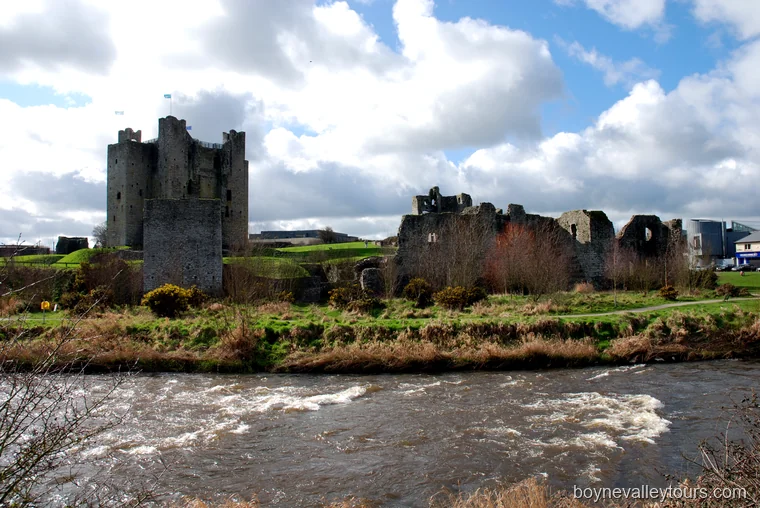 Trim Castle above the River Boyne
Hugh de Lacy and the Lordship of Meath
Trim takes its name from the Irish Baile Átha Troim, the town of the ford of the elder trees. Long before the Normans arrived, the Boyne crossing made this a strategic place. An early monastery is traditionally linked with St Patrick, and although nothing of that first church survives above ground, archaeological evidence points toward the area around today’s St Patrick’s Cathedral. A settled community, good farmland, and the ford made Trim a natural capital once Hugh de Lacy took control of Meath.
Hugh de Lacy (c.1135 to 1186) came from a landed family in Herefordshire and Shropshire. He crossed to Ireland with King Henry II in 1171 as part of the main Anglo-Norman force. When Henry sought to balance the rising power of Strongbow in Leinster, he granted Meath to de Lacy: a vast holding covering modern Meath and Westmeath, with parts of Kildare, Offaly, and Wicklow. De Lacy still had to take and hold that land. He raised motte-and-bailey defenses across his estates, with Trim as the center of power rather than Drogheda.
His first fortification at Trim was a timber ringwork behind earth banks. In 1174 it was captured and burned by Ruaidrí Ua Conchobair (Rory O’Connor), the last High King of Ireland, during a campaign to push the Normans out. De Lacy rebuilt in stone. The keep became both residence and center of administration. After his assassination at Durrow in 1186, his son Walter inherited the castle and raised the keep by another story. Later, Walter’s granddaughter Maud and her husband Geoffrey de Geneville added a great hall in the bailey; its rectangular footprint is still easy to spot from the roof of the keep. Later owners included the Mortimers, and the castle eventually became a royal property. By around 1500 it guarded the north-western frontier of the Pale as English control in Ireland narrowed.
The castle sat inside a wider walled town. Little of the town wall survives, but the Sheep Gate still stands on the far bank of the Boyne, near the Yellow Steeple of the former Augustinian house of St Mary’s. Richard II visited Trim in 1399 and left Prince Hal, later Henry V, as a prisoner in the castle. The fortress declined long before the seventeenth century and was never remodelled into a Georgian or Victorian country house. That long quiet is part of why so much original Norman fabric survives.
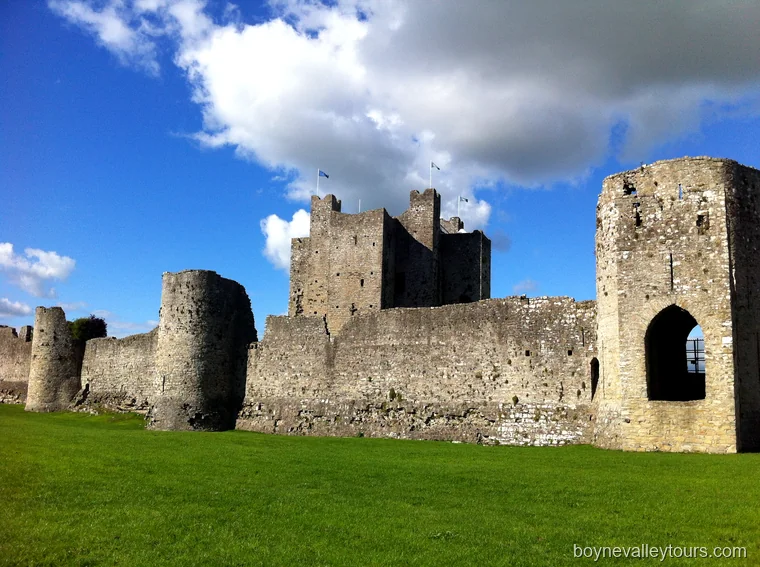 Curtain wall and keep at Trim Castle
The keep, curtain walls and Boyne setting
The keep is the heart of the fortress. From above it reads as a cross, with towers projecting north, east, south, and west, creating a rare twenty-sided plan. All of those towers survive except the northern one. Walls about 3 meters (10 feet) thick show experimental military architecture of the late twelfth and early thirteenth centuries. Rows of square putlog holes still mark the stonework. They once held timber hoardings, covered fighting walks from which defenders could shoot or drop stone onto attackers below. Around the keep, the curtain wall, ditch, and surviving towers still mark the defended bailey. Approached past the Barbican Gate, the castle remains every inch the formidable bastion it was designed to be.
The riverside setting explains the whole strategic choice. From the north bank and the Porchfields, the keep and ruined ranges still command the water and the open landscape beyond. Discover Ireland notes Ireland’s oldest complete and unaltered bridge beside the castle, built across the Boyne in 1393. A walk along the opposite bank of the Boyne is worth adding for views back to the walls and Trim’s medieval skyline.
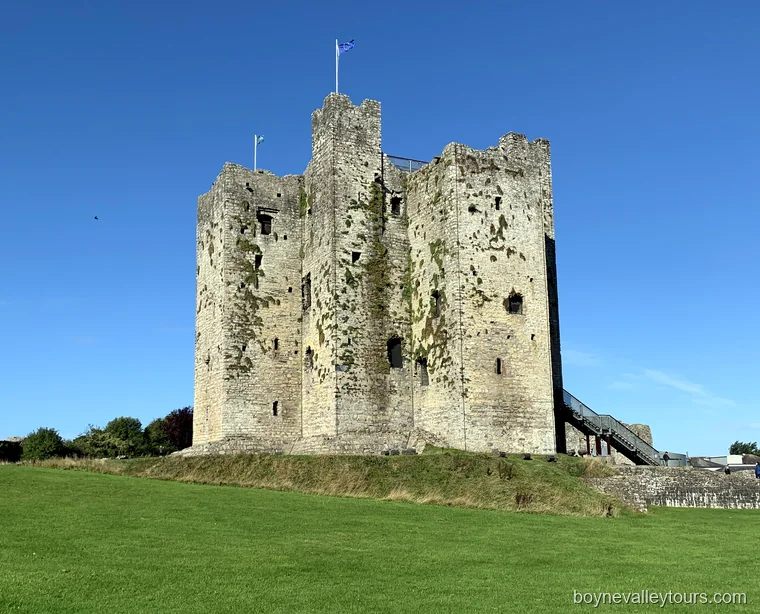 Visitor stairs to the keep entrance at Trim Castle
Visiting Trim Castle
Trim Castle is managed by the Office of Public Works. The castle grounds are free to walk, with interpretation panels for self-guiding. Access to the keep is only on a guided tour with the onsite OPW guides. That tour takes visitors through the floors and usually onto the roof for views across Trim and the Boyne Valley. Inside, modern walkways give safe access without pretending to restore lost floors, so you can still read the building phases in the stone.
Expect grass, gravel and uneven historic surfaces outdoors, and steps with narrow spiral stairs inside the keep. Access for visitors with disabilities is restricted: the keep is not accessible, with limited access to the grounds. Allow about 1 to 2 hours. Assistance dogs are welcome. For visitor safety, an Automated External Defibrillator (AED) is on site.
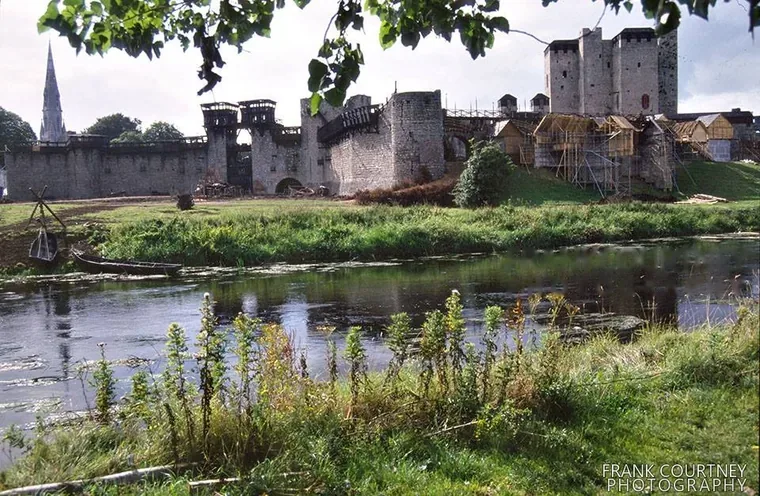 Trim Castle during filming for Braveheart
Trim Castle was used during the shooting of Mel Gibson’s 1995 historical drama Braveheart. The Hollywood fame is real enough, but the OPW keep tour returns attention to Hugh de Lacy, the Pale and the Norman military architecture still standing beside the Boyne. Nearby Bective Abbey was also used as a film location.